Is plugging in mandatory for EV charging?
When a vehicle pulls into a parking spot and comes to a complete stop, it can automatically begin charging without the driver ever having to search for a charging gun or leave the vehicle to plug or unplug a cable.
Taking it a step further, when the power grid needs electricity, energy stored in the EV battery can be fed back into the grid through the same system.
This is precisely the frontier explored by bidirectional wireless charging.
Recently, HzI, in joint development with Professor Tan Linlin's team from Southeast University, successfully developed a 32kW bidirectional wireless charging system for new energy vehicles (EVs). Designed for wireless EV charging and Vehicle-to-Grid (V2G) interaction scenarios, the system utilizes magnetic coupling resonant wireless power transfer technology. By combining power conversion with wireless energy transfer, it enables bidirectional wireless power flow between the three-phase power grid and the vehicle's power battery.
The system achieves over 32kW in both forward and reverse power transfer, with transmission efficiency exceeding 94% in both directions—further broadening the application scenarios for high-power wireless charging in the EV sector.

Why Develop "Bidirectional" Wireless Charging?
The logic behind traditional EV charging is simple:
Power Grid → Charging Equipment → EV Battery
Electricity moves from the grid into the EV to complete charging. However, as electric vehicles, autonomous driving, and V2G technologies evolve, EVs are shifting from pure "power consumers" toward becoming mobile energy storage units.
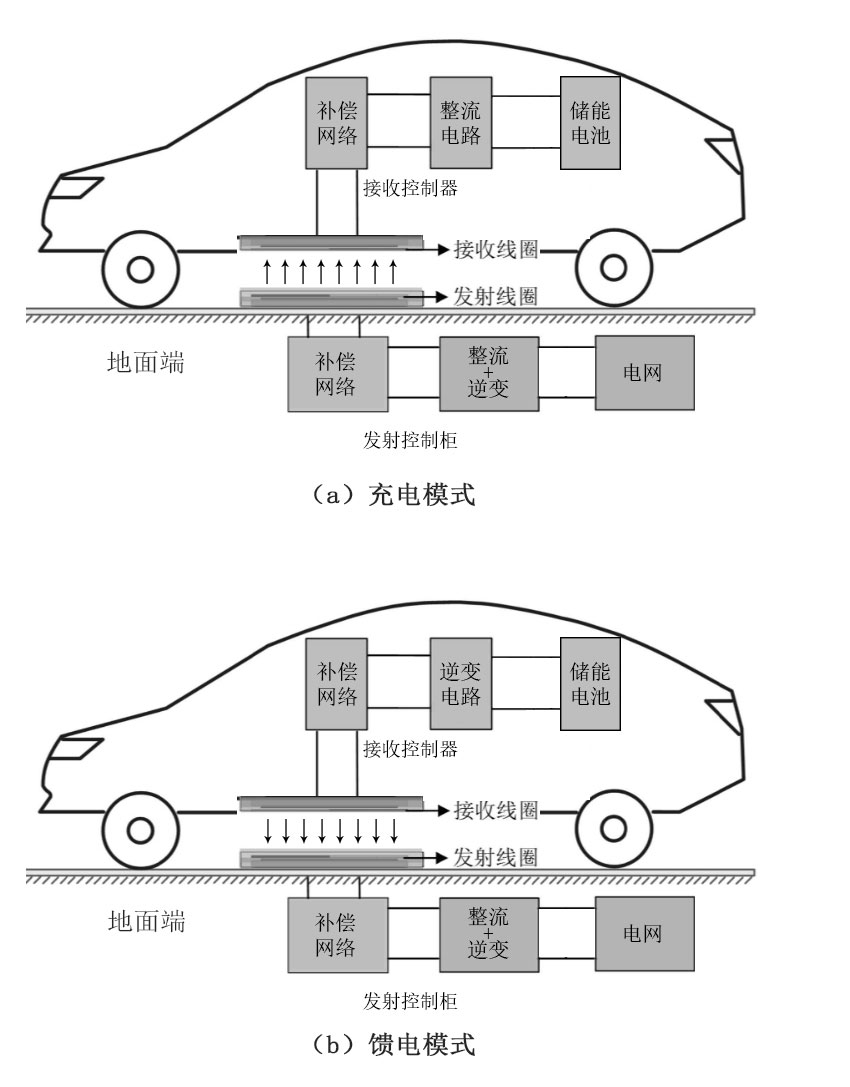
Bidirectional Wireless Charging System:
Moving from "unidirectional charging" to "bidirectional energy interaction" represents one of the core values of this 32kW bidirectional wireless charging system.
One System, Bidirectional Energy Flow
This 32kW bidirectional wireless charging system consists of core units including a transmitter control cabinet, transmitting coil, receiving coil, and receiving controller. It uses bidirectional AC/DC modules and full-bridge power conversion circuits to achieve wireless energy transfer.
Forward Charging: Powering the Electric Vehicle
When the vehicle needs charging, electricity flows from the three-phase grid into the system. After power conversion, the energy is directed to the ground-side transmitting coil, generating an alternating magnetic field. The vehicle-side receiving coil captures the energy via magnetic coupling, which then undergoes power conversion on the vehicle side to charge the power battery.
Path: Three-Phase Grid → Power Conversion → Transmitting Coil → Receiving Coil → Power Conversion → Vehicle Battery
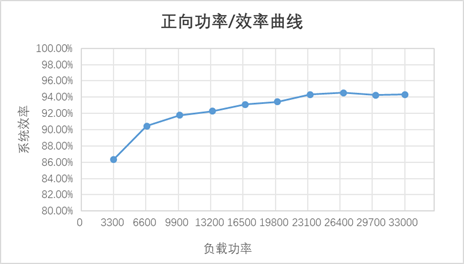
Electrical specs include a forward output voltage range of 200–800Vdc, output current range of 0–40A, and a rated output power of no less than 32kW. At a 20cm transmission distance, the coupling coefficient between the coils is approximately 0.229, leveraging an LCC-LCC compensation network for high-power wireless transfer.
Test results show a forward transmission power of 33kW. In full-power efficiency tests, with 34.983kW input from the grid, output on the vehicle side reached ~33.0kW, yielding an efficiency of 94.33%—completely eliminating physical charging cables.
Reverse Feeding: EVs Supplying Power Back
If forward mode addresses how EVs charge, reverse mode answers another question: Can the electricity inside the EV battery be fed back out?
The answer is yes.
When switching to reverse mode, the direction of energy transfer flips. Battery power undergoes conversion on the vehicle side, transfers from the vehicle coil to the ground coil wirelessly, and is converted again on the ground side before feeding back into the grid.
Path: Vehicle Battery → Power Conversion → Receiving Coil → Transmitting Coil → Power Conversion → Three-Phase Grid
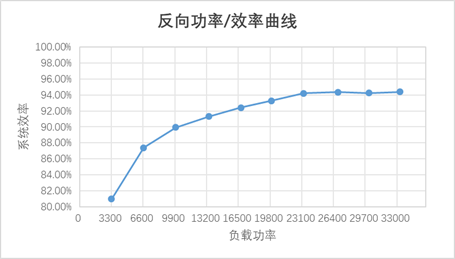
Reverse mode supports a 200–800Vdc DC input range, max DC input power of 36kW, max input current of 45A, and an AC output voltage of 320–530Vac at no less than 32kW (supporting 50Hz/60Hz AC output).
In full-power reverse testing, with a 35.272kW input from the vehicle, grid feedback reached 33.289kW, achieving a 94.38% transmission efficiency. A single wireless system thus creates a two-way energy highway: grid-to-vehicle when charging, and vehicle-to-grid in reverse.
What Does 32kW Mean for the Future?
Combining high power with bidirectional wireless transfer shifts not just how fast vehicles charge, but how, when, and where energy flows.
Park-and-Charge: Vehicles park over designated ground pads to initiate charging automatically, removing the need to manually handle heavy charging cables. Ideal for home, public, and commercial parking spaces.
Auto-Parking + Wireless Charging: Merges self-parking with automated alignment and charging. The workflow simplifies to: Auto-Park → Auto-Align → Wireless Charge → Drive Away.
Unmanned Fleet Operations: Essential for driverless delivery vehicles and campus shuttles that require frequent replenishment, removing human intervention from the loop and reducing physical connector wear.
V2G (Vehicle-to-Grid): Transforms massive EV fleets into distributed power banks. EVs charge during off-peak hours and feed energy back during peak demand, assisting in grid load balancing.
From Power Consumers to Energy Providers
This joint development marks a key technological breakthrough for HzI in high-power bidirectional wireless power transfer. Looking ahead, both parties will continue optimizing the system, expanding its validation across EVs, smart vehicles, and V2G ecosystems to support high-power, wireless, and intelligent charging infrastructure.
As L3 autonomous driving deployment accelerates, HzI will deepen its research into high-power wireless charging, driving technological breakthroughs toward rapid commercial adoption.